
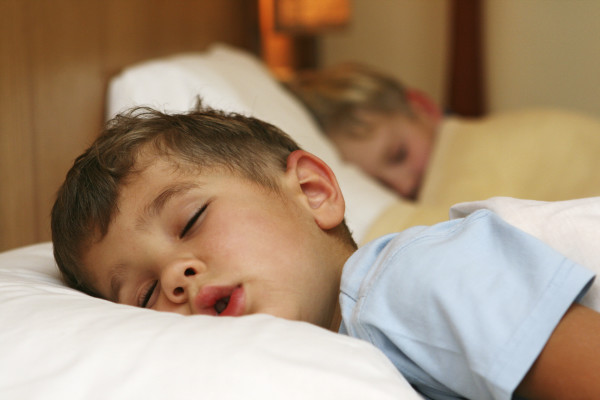
Your Child is Emotionally Tired. Do your find your child’s behaviour difficult to manage or is he having trouble socially or academically at school? Children who are overtired have difficulty regulating their mood, maintaining attention and behaving appropriately.
Your Child is Physically Tired. If your little one is always sick or prone to accidental injury it may because he’s not getting enough sleep. Kids who are sleep deprived tend to have decreased immune function and increased risk for accidental injury.
Your Child is Physiologically Tired. If your little one is sluggish, physically inactive or overweight, poor sleep may be a factor. When our children are sleep deprived their bodies experience an increase in ghrelin (the hormone which tells them to eat) and a decrease in the leptin (the hormone which tells them to stop eating).
How Do You Change it? Make a Sleep Resolution
Knowing your child needs to spend more time between the sheets and making it happen are two different things. So what can you do, right now, to help your little one get the sleep he needs?
First, recognize that children need more sleep than adults. A well-rested child is one who wakes up happily at the same time every day without an alarm clock. If your baby always wakes up crying or if you’re dragging your 6 year old out of bed to get to school on time you have an overtired child. Determine how much sleep your child would need to wake up in a well-rested state. Each child is unique but on average babies 3-12 months need about 14-15 hours per day, 12 months-preschool need 12-14 hours per day and children ages 4-9 years need an average of 10-11.5 hours of sleep a day.
Next, utilize an early bedtime whenever possible. If you have school aged children with after school activities you might not be able to get your kids to be early every night, but even a few nights a week is helpful. It’s during the sleep cycles which happen prior to midnight that our children benefit from the secretion of the human growth hormone. This is when their bodies physically repair themselves. It’s early bedtime sleep which helps children make up for late nights, recover from illness and develop physically.
Focus on quantity and quality sleep. The amount of sleep your child gets is critical but it’s also important that sleep is as restorative as possible. You can have your little one to bed early but if she’s up 3 times in the night you’re no further ahead. Make the bedroom as dark as possible by using black out blinds. Remove night lights and any devices with blue wave light from the sleep environment. Consider using white noise to drown out household sounds which could interfere with an early bedtime. Power down electronics well before bedtime to avoid interference with the body’s natural production of melatonin which makes falling asleep difficult. Finally, understand that children who are suffering nightmares and night terrors are usually in an overtired state and getting more sleep will often remedy the problem. An early bedtime is critical for a sleep sensitive child who is up in the night due to bad dreams.
Not Forget to Share :)
References
Ferber, R. (2006). Solve Your Child’s Sleep Problems. New York: Simon & Schuster.
Gruber, R. (2013). Making room for sleep: The relevance of sleep to psychology and the rationale for development of preventative sleep education programs for children and adolescents in the community. Canadian Psychology, 54(1), 62-71.
Magee, C.A., Gordon, R. & Caputi, P. (2014). Distinct developmental trends in sleep duration during early childhood. Pediatrics, 133(6), e1561-1567.
Mindell, J.A., Kuhn, B., Lewin, D.S., Meltzer, L.J., & Sadeh, A. (2006). Behavioral treatment of bedtime problems and night wakings in infants and young children. Sleep, 29(10), 1263-1276


0 Response to "Why Your Child Needs More Sleep This Year And How To Make It Happen"
Post a Comment